

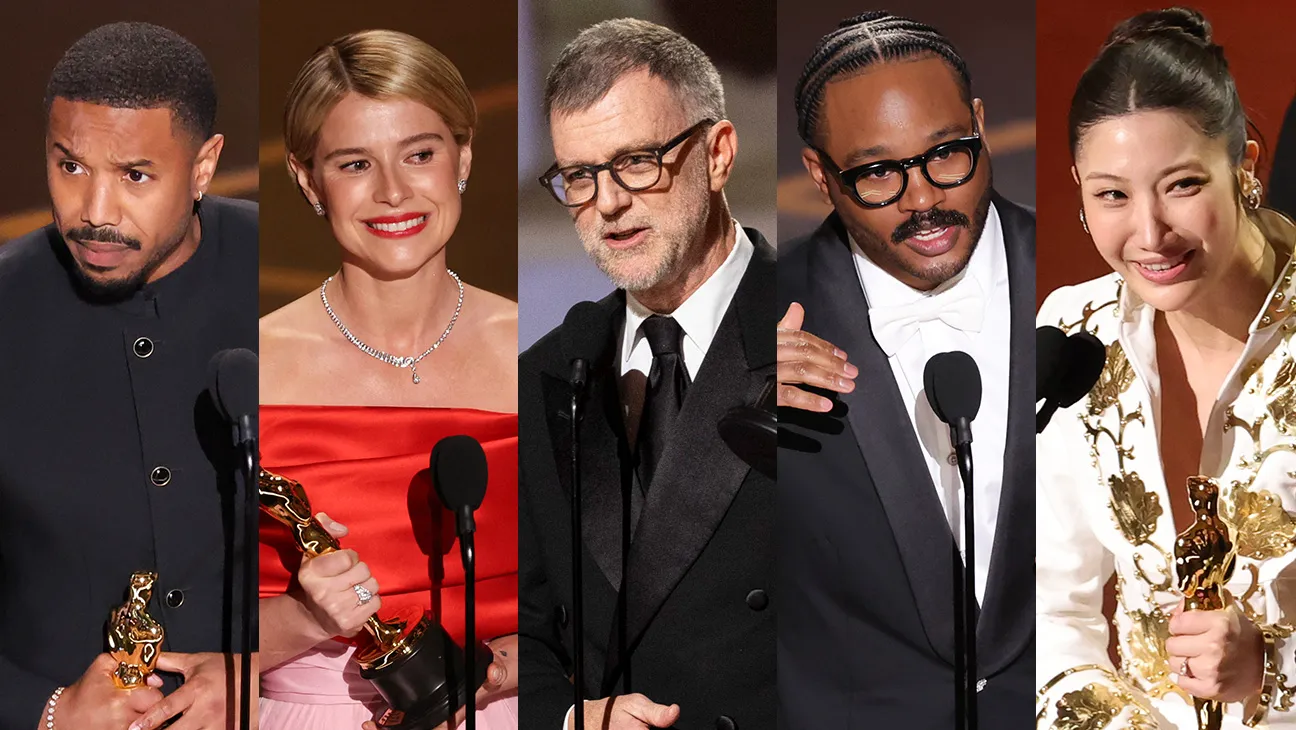

Hollywood's Biggest Week: Oscars Crown PTA While SXSW Bets on Genre
The 98th Academy Awards and SXSW 2026 collided in real-time this past weekend, offering a rare split-screen view of where the film industry is and where it's heading.
The ceremony aired live from the Dolby Theatre at Ovation Hollywood on ABC and Hulu, starting an hour earlier than prior years at 7 PM ET. Conan O'Brien returned as host for a second consecutive year. The theme was "Humanity", a pointed choice in a year when AI anxiety dominated the industry conversation.
Paul Thomas Anderson finally claimed his Oscar coronation, after going 0-for-11 across his 30-year career, winning Best Picture, Director, and Adapted Screenplay for One Battle After Another.
“You make a guy work hard for one of these”
Meanwhile in Austin, Boots Riley, Damian McCarthy, and a wave of genre filmmakers signalled that Hollywood's next chapter belongs to bold, unclassifiable storytelling. Here's everything that happened, what it means, and what you need to know.
The Winners, The Snubs, The Well Deserved:
One Battle After Another led with 6 wins from 13 nominations. Sinners won 4 from a record-breaking 16 nominations, the most noms in Oscar history, surpassing All About Eve, Titanic, and La La Land. Frankenstein swept the production design trifecta with 3 wins. Marty Supreme, Train Dreams, Bugonia, The Secret Agent, It Was Just An Accident, and Song Sung Blue went home empty-handed.
- Best Picture: One Battle After Another — Paul Thomas Anderson, Sara Murphy
- Best Director: Paul Thomas Anderson — One Battle After Another
- Best Actor: Michael B. Jordan — Sinners
- Best Actress Jessie Buckley — Hamnet
- Best Supporting Actor: Sean Penn — One Battle After Another
- Best Supporting Actress Amy Madigan — Weapons
- Best Adapted Screenplay: Paul Thomas Anderson — One Battle After Another
- Best Original Screenplay: Ryan Coogler — Sinners
- Best Animated Feature: KPop Demon Hunters — Maggie Kang, Chris Appelhans, Michelle L.M. Wong
- Best International Feature: Sentimental Value — Norway (Joachim Trier)
- Best Documentary Feature: Mr. Nobody Against Putin — David Borenstein, Pavel Talankin, et al.
- Best Cinematography: Autumn Durald Arkapaw — Sinners
- Best Film Editing: Andy Jurgensen — One Battle After Another
- Best Sound: F1 — Gareth John, Al Nelson, Gwendolyn Yates Whittle, Gary A. Rizzo, Juan Peralta
- Best Visual Effects: Avatar: Fire and Ash — Joe Letteri, Richard Baneham, Eric Saindon, Daniel Barrett
- Best Original Score: Ludwig Göransson — Sinners
- Best Original Song"Golden" from KPop Demon Hunters — EJAE, Mark Sonnenblick, et al.
- Best Production Design: Frankenstein — Tamara Deverell, Shane Vieau
- Best Costume Design: Frankenstein — Kate Hawley
- Best Makeup and Hairstyling: Frankenstein — Mike Hill, Cliona Furey, Jordan Samuel
- Best Animated Short: The Girl Who Cried Pearls
- Best Live Action ShortTIE: The Singers AND Two People Exchanging Saliva (7th tie in Oscar history)
- Best Documentary Short: All the Empty Rooms
- Best Casting (inaugural): Cassandra Kulukundis — One Battle After Another
What the results reveal about Academy taste in 2026
The award distribution tells a clear story about who the Academy voters are right now and what they value.
One Battle After Another swept the narrative craft categories: Director, Adapted Screenplay, Editing, and the new Casting award.
While Sinners dominated technical-artistic prizes: Cinematography, Original Screenplay, Original Score, and Actor.
The design categories consolidated around Frankenstein, and the blockbuster technical awards (Avatar: Fire and Ash for VFX, F1 for Sound) went to the expected big spectacle films. This distribution pattern shows voters 'spreading the wealth' rather than coronating a single film, but the top prize still gravitated toward an auteur period drama over a genre-bending populist sensation.
The Academy gives horror a moment
The Academy nominated horror (Sinners, Weapons) more meaningfully than perhaps ever before. Amy Madigan's Supporting Actress win for a horror performance is genuinely unprecedented, but Best Picture still defaulted to the PTA prestige model.
Also, a new voting verification rule requiring members to certify they'd watched all nominees before voting reportedly caused ballot glitches, with some longtime members skipping voting entirely rather than navigate the system. So really, the reduced voting pool may have favoured guild-backed consensus picks.
My favourite films of the year didn't make it to the Oscars, partly because they never got screened in LA. But that's a rant for my Substack.
SXSW 2026: March 12–18, Austin, Texas: My Analysis (Part 1)
The good news is, SXSW is leaning hard into genre and comedy
SXSW's 33rd Film & TV Festival — celebrating the overall organization's 40th anniversary SXSW is running concurrently with all SXSW programming for the first time. The festival features 119 feature films and 49 world premieres across venues in Austin. The festival overlapped directly with the Oscars on March 15, splitting industry attention between Austin and Hollywood.
Opening night delivered a double bill: Boots Riley's I Love Boosters (Neon, theatrical May 22) and Apple TV+'s series Margo's Got Money Troubles (premiering April 15). Senior programmer Peter Hall noted this year's lineup is "actually very strong on comedy," but genre filmmaking dominates across all categories.
Films generating the strongest buzz
Hokum (Damian McCarthy, starring Adam Scott) has emerged as the festival's breakout. This Irish supernatural folk horror set in a remote hotel is drawing ecstatic reviews. Dread Central called it "groundbreaking... the most deeply unsettling images I've seen in ages." Daily Dead declared it "an early frontrunner for best horror movie of the year." Neon holds the theatrical release for May. For anyone tracking horror's continued mainstream push, this is the title to watch.
I Love Boosters has been divisive but electric. Variety called it "a more spirited piece of fun than Sorry to Bother You... an incendiary prank of a movie." Screen Daily praised Keke Palmer as "among the best comedic actresses of her generation." The film is described as a cosmic send-up of fashion consumerism, featuring Palmer alongside Naomi Ackie, Taylour Paige, Demi Moore, and LaKeith Stanfield.
Campeón Gabacho by Jonás Cuarón (son of Alfonso) is drawing early Do the Right Thing comparisons from Deadline for its story of a Mexican migrant boxer in New York. Black Bear is holding it for an August 14 theatrical release.
Forbidden Fruits (Meredith Alloway, exec-produced by Diablo Cody) features Lili Reinhart, Victoria Pedretti, and Lola Tung in a mall witch coven comedy Filmmaker Magazine being described as "The Craft for Gen Z."
Family Movie, co-directed by and starring Kevin Bacon and Kyra Sedgwick alongside their actual children, earned positive notices as a meta horror about a filmmaking family.
On the TV side, Margo's Got Money Troubles (David E. Kelley; Elle Fanning, Michelle Pfeiffer, Nicole Kidman) received universal praise, IndieWire says "everything screams Emmy campaign."
AMC's The Audacity (from Succession and Better Call Saul alums) and Prime Video's BAIT starring Riz Ahmed round out notable TV premieres.
Spielberg's anti-AI declaration was the week's biggest headline
Steven Spielberg made international news on March 13 during a live taping of The Big Picture podcast. He declared: "I've never used AI on any of my films yet. We have a writer's room. All the seats are occupied. There's not any chair with a laptop in front of it." He drew enthusiastic applause when stating, "I am for AI in many different disciplines. I am not for AI that replaces a creative individual." This landed especially hard given Netflix's recent ~$600 million acquisition of an AI filmmaking company associated with Ben Affleck.
Spielberg also unveiled the trailer for Disclosure Day (June 12, 2026, starring Emily Blunt and Josh O'Connor), revealed he's developing a western to shoot in Texas, and stated his belief that extraterrestrial life exists and is present on Earth.
AI dominated the panel slate. Sessions included "The Creative Renaissance: AI & The True Impact on Film Production," "Bending Reality: Scaling Film Productions with AI Workflows," and "Behind the Scenes: Empowering Production with AI Tools," covering automated script breakdowns and real-time compliance tools.
Distribution, labor, and the indie pipeline crisis
SXSW 2026 reveals an accelerating trend: studios now use the festival as a launchpad rather than an acquisition market. Ready or Not 2 premieres at SXSW March 12, hits theatres March 20, an 8-day turnaround. Pretty Lethal (Amazon) drops March 25. Mike & Nick & Nick & Alice lands on Hulu March 27. The days of SXSW as a pure discovery-to-deal festival are fading; the major buyers bring finished products with release dates already locked.
This creates a squeeze for true independents. A panel titled "You Made a Great Film. Now What?" explored alternative distribution strategies, including grassroots outreach, community-driven campaigns, and eventized theatrical runs; framed explicitly around streamers scaling back and "traditional buyers pulling out." Another critical panel, "Producing Boldly in Post-DEI Hollywood," addressed how underrepresented producers build commercial leverage as institutional DEI support erodes, featuring executives from Kas Kas Productions, Macro Film Studios, and Gold House.
The SXSW 2026 program reads as an industry grappling simultaneously with technological disruption, political pressure, and economic contraction — while still producing ambitious, boundary-pushing work.
What this week tells us about the industry right now
The simultaneous Oscars and SXSW offer a revealing composite portrait. The Academy coronated an auteur master (Anderson) while rewarding genre penetration (horror wins for Madigan, vampire cinema honoured through Coogler and Jordan) more than in any prior year...but stopped short of giving the top prize to a genre film despite record nominations. The message: the Academy will invite genre films to the table, but still seats prestige drama at the head. Meanwhile, SXSW's programming, dominated by horror, comedy, and unclassifiable work from directors like Boots Riley and Damian McCarthy, suggests the next generation of filmmakers isn't waiting for permission.
From Bardem's "Free Palestine" to Borenstein's ICE speech to Fonda's First Amendment keynote, also confirms that silence is no longer an option for the creative class, even as federal pressure mounts.
The AI fault line is now fully exposed. Spielberg's declaration in Austin, O'Brien's jokes at the Dolby, the Oscars' "Humanity" theme, and SXSW panels on AI workflows all point to an industry that knows the disruption is coming but hasn't agreed on how to respond. The distribution crisis for independent filmmakers is real: SXSW's shift from acquisition market to studio launchpad leaves true indies scrambling for new models.
For filmmakers, producers, and media professionals reading this: the week's core takeaway is that craft still wins awards, genre is finally getting respect, and the business model underneath everything is in active transformation. The films being celebrated (Anderson's meticulous Vineland adaptation, Coogler's genre-exploding Sinners, McCarthy's classical Hokum) share one quality...they are defiantly, unmistakably the product of singular human vision. That may be the most important signal of all.


