


Indie Films Are Winning, & They're Winning With A Solid Distribution & Merchandising Strategy.
The traditional indie film revenue model is fundamentally broken.
You're fighting for festival acceptance - spending $5,000+ on submission fees alone. Then comes marketing at $15,000 minimum. If you're lucky enough to land a distribution deal, they'll take 25-35% of your gross. Your actual profit? Hope, prayers, and MAYBE just enough left over to pay back your and your crew's over-leveraged credit cards.
But while you're chasing that broken model, you're sitting on a gold mine that large media businesses like Disney take full advantage of.
The Disney Playbook (That You Can Actually Use)
Disney makes more money from Baby Yoda plushies than most indie films gross worldwide. That's not hyperbole, that's business.
Need proof?
Disney did not release specific figures for "Baby Yoda" (Grogu) merchandise, but the character's popularity has contributed significantly to the overall $29 billion in Star Wars merchandise sales, reports License Global.
But here's what the gatekeepers don't tell you: you don't need a billion-dollar franchise to tap into merchandising revenue.
Let me break down the real math:
Traditional Revenue Model:
- Festival submissions: -$5,000
- Marketing budget: -$25,000+
- Distribution takes: -25-35% of gross
- Your profit: Whatever's left (usually not much)
Merchandise Revenue Model (Single T-Shirt):
- Production cost: $8
- Retail price: $35
- Your profit margin: 70% ($27)
- Distribution middleman: $0
You read that right. Zero middlemen. One well-designed shirt featuring your film's iconic quote or character can generate $27 profit, and you keep it all. (provided you know and have all your rights!)
The Paradigm Shift: From Content to Brand
Here's the shift that's happening right now in 2025: your film isn't just a production to be watched, it's a brand to be worn, displayed, and shared.
Strategic brand partnerships and merchandise collaborations provide filmmakers with access to new marketing channels and potential viewers without significant additional costs. Young audiences especially want to signal their identity through what they wear and independent films have become the new band t-shirts.
Think about it: when was the last time someone wore a Netflix logo shirt to signal their taste? Never. But A24? Neon? A24's merchandise has become so coveted that people line up for hours at pop-up shops just to get limited-edition pieces.
Case Study: Everything Everywhere All At Once

Let's talk about the film that changed everything for indie merchandising in recent years.
Everything Everywhere All At Once had a production budget of $14 million, modest by studio standards, massive for true indies. But here's where it gets interesting: the film generated millions in merchandise revenue.
What sold?
Googly eyes became a merchandising phenomenon. Such a phenomenon caused a googly eye shortage. Hot dog finger oven mitts sold out in 48 hours. When A24 auctioned off props from the film, they raised over $555,000 for charity. A pair of hot dog hands sold for $55,000, with proceeds benefitting the Laundry Workers Center. A single rock with a googly eye sold for $13,200
Think about that. A rock. With a googly eye. Thirteen thousand dollars.
This wasn't accidental. These visual symbols resonated emotionally with audiences. The googly eyes represented kindness and joy in the face of existential dread.
ANYWAY, I do want to say,
Audiences didn't just want to watch that philosophy they resonate with deeply, they wanted to live it, wear it, share it, even bond over them with other folks. If sports fans can do it, why can't moviegoes? You can quote me on that.
Case Study: The Room - Bad Movie, Brilliant Business Model
Now let's look at a film everyone loves to hate: The Room.
The film lost $6 million at theatrical release. By every traditional metric, it was a catastrophic failure. But today? The Room generates over $2 million annually in profit from merchandise and special screenings.
The breakdown:
- Spoon merchandise alone: $50K per year
- "Oh Hi Mark" t-shirts: Evergreen seller for 20 years
- Total annual revenue: $2M+
Tommy Wiseau understood something crucial: big films don't need to be good, they need to be memorable. And memorable moments are merchandisable moments and worth their weight in sentimental or silly keepsake .
Case Study: Blair Witch Project - Building An Empire From $60K
The Blair Witch Project was made for approximately $60,000 during principal photography. It went on to gross $248 million worldwide—one of the most profitable films ever made relative to budget. But the story doesn't end with theatrical revenue.
The Merchandising Strategy:
What many people don't realize is that the film's total budget balloons when you include post-production and marketing. According to Stanford's case study, when Artisan Entertainment acquired the film at Sundance for $1.1 million, they invested heavily in a marketing campaign that eventually reached $8 million. But this wasn't traditional advertising; it was world-building that created merchandising opportunities.
The production team, led by directors Daniel Myrick and Eduardo Sánchez, launched a website in 1998 that treated the Blair Witch legend as real. They created a detailed timeline of witch-related events dating back to the 1700s, fake police reports about the missing students, and exclusive "found footage" snippets. Before the film even hit theaters, the website had received over 20 million visitors, massive numbers for 1999.
re
This world-building created demand for merchandise that extended the mythology. T-shirts, posters, and collectibles allowed fans to own pieces of the "documentary." The filmmakers even manipulated IMDb records so that if you looked up the actors, their bios listed them as "missing, presumed dead."
The Long-Term Play:
Twenty-five years later, Blair Witch merchandise still sells. The brand has outlived the theatrical run by decades because the team understood from day one that they weren't just making a film—they were building intellectual property. Variety reported in 2024 that the film's approach to online marketing became a template that horror movies and indie films still follow today.
The controversial aspect: the actors themselves were largely cut out of merchandising profits. Heather Donahue, Michael C. Williams, and Joshua Leonard reportedly received only a one percent participation in profits exceeding $1 million, and friends and family kept seeing merchandise featuring the actors' names and faces. They reached a $300,000 settlement each in 2000, but by then, the merchandising machine was already generating millions.
The lesson for independent filmmakers: get merchandise rights in writing from day one. The Blair Witch team protected their IP rights, but failed to adequately compensate the talent. You can—and should—do both.
The Numbers Nobody Shows You
Here's what a realistic merchandising model looks like for an indie film with 10,000 engaged social media followers:
Conservative Projection (Year 1):
- 1% conversion rate = 100 customers
- Average order value: $45
- Monthly revenue: $4,500
- After costs (30%): $3,150 profit
- Annual projection: $37,800
Realistic Projection (With Marketing):
- 3% conversion rate = 150 customers
- Average order value: $65
- Monthly revenue: $9,750
- After costs and marketing: $5,850 profit
- Annual projection: $70,200
That $70K could fund your next film. Or pay back investors. Or actually let you make a living as a filmmaker.
Why This Works Now (And Didn't Before)
Three factors have converged to make this moment perfect for film merchandising:
1. Print-on-Demand Technology:
You don't need $10,000 upfront for inventory anymore. Platforms like Printful and Printify handle production and shipping automatically. Upload your design, set your price, and they fulfill orders as they come in. The technology has matured to where quality is comparable to bulk manufacturing for most basic products.
2. Social Commerce Integration:
Instagram Shopping, TikTok Shop, and Facebook Marketplace let you sell directly where your audience already spends their time. According to the guide's research, digital marketing channels now account for over 50% of film promotion budgets, and social commerce has made the path from "I love this film" to "I just bought the shirt" instantaneous.
3. Identity Culture Shift:
This is perhaps the most important factor. Gen Z and millennials want to wear their taste. As one Anora fan explained while waiting hours at a Neon merchandise pop-up: "Being this film buff type of person, I buy Blu-rays, I buy 4Ks. And that's not something that you can just pop out to someone and be like, 'I have this Criterion.' Merch is the second-best option of saying like, 'I do love movies and this is the way to express that.'"
Christian Parkes, Neon's Chief Marketing Officer, explained it perfectly: "People, and particularly younger people, they want to be a part of something. And wearing a shirt for a movie is no different to wearing a shirt for the band that you just went to see. There's a cachet to it. There's a value to it. It's a sign of who I am."
Independent film merchandise has become a form of cultural currency, a way to signal shared interests, tastes, insider knowledge, and community belonging in an increasingly rigid, fragmented(but in a vase shattering way), argumentative-on-the-internet, very trigger friendly media landscape. There, I said it. You can quote me on that.
The Three Types of Buyers (And How to Serve Them)
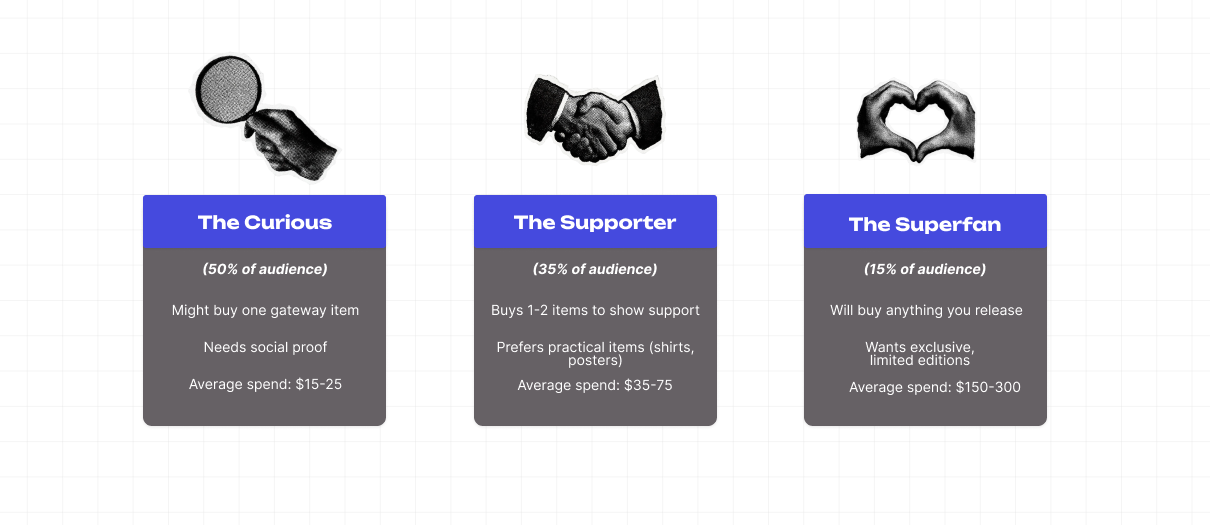
Understanding your audience psychology is crucial:
The Superfan (15% of your audience):
- Will buy anything you release
- Wants exclusive, limited editions
- Average spend: $150-300
- Strategy: Create high-margin collectibles
The Supporter (35% of your audience):
- Buys 1-2 items to show support
- Prefers practical items (shirts, posters)
- Average spend: $35-75
- Strategy: Make great basics
The Curious (50% of your audience):
- Might buy one gateway item
- Needs social proof
- Average spend: $15-25
- Strategy: Low-barrier entry products (stickers, digital items)
Getting Started
You need three strategic products:
- Gateway Product ($3-12): Stickers or enamel pins—low cost, high impulse purchase rate
- Hero Product ($35-50): Iconic quote t-shirt or art print
- Premium Product ($100-200): Limited edition signed poster or prop replica
Start there. Test. Learn what resonates. Then expand.
The Bottom Line
The global movie merchandise market is valued at $32.5 billion and growing at 3.2% annually through 2031. Meanwhile, the independent box office shrank by over 17% in 2024,* with indie films now accounting for just 18.5% of theatrical revenue; down from 21% in 2023. *NOTE: it is very difficult to estimate the exact revenue for independent films but going by the top 10 best performing ones of every year, you can get an indication of how popular indie films have been getting. Numbers aside, 2024 was an incredible year for indie films.
The writing is on the wall: traditional distribution is shrinking. Direct-to-consumer merchandising is exploding.
As one industry report noted, factors that conventional wisdom claims determine success like genre or which platforms a film appears on, actually show no clear trends. The only consistent pattern? Films with recognizable talent and strategic merchandising partnerships tend to generate sustainable revenue.
Your film is more than 90 minutes of entertainment. It's a brand waiting to be built. And you don’t have to do it alone. While other filmmakers are begging distributors for scraps, you can build a revenue stream that nobody can take away from you.
Ready to turn your film into a wearable, sharable IP? Download our free e-book 'THE NEW ENTERTAINMENT ECONOMY' and learn how to approach building demand and an audience for your own creative projects.


